Inspection Guidelines
Swell
A swell is characterized by an upward bulge in the pavement's surface. A swell may occur sharply over a small area or as a longer, gradual wave. Either type of swell can be accompanied by surface cracking. A swell is usually caused by frost action in the subgrade or by swelling soil, but a small swell can also occur on the surface of an asphalt overlay (over PCC) as a result of a blow- up in the PCC slab.
How to Measure
The surface area of the swell is measured in square feet (square meters). The severity rating should consider the type of pavement section (i. e., runway, taxiway, or apron). For example, a swell of sufficient magnitude to cause considerable roughness on a runway at high speeds would be rated as more severe than the same swell located on the apron or taxiway where the normal aircraft operating speeds are much lower. The following guidance is provided for runways:
| Severity | Distress Example | Description |
|---|---|---|
| Low | 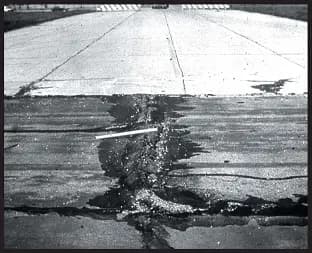 | Swell is barely visible and has a minor effect on the pavement's ride quality as determined at the normal aircraft speed for the pavement section under consideration. (Low-severity swells may not always be observable, but their existence can be confirmed by driving a vehicle over the section at the normal aircraft speed. An upward acceleration will occur if the swell is present). Height Differential: < 3/4 inch (< 19 mm) |
| Medium | Swell can be observed without difficulty and has a significant effect on the pavement's ride quality as determined at the normal aircraft speed for the pavement section under consideration. Height Differential: 3/4 – 1 1/2 inches (19 – 40 mm) | |
| High | Swell can be readily observed and severely affects the pavement's ride quality at the normal aircraft speed for the pavement section under consideration. Height Differential: > 1 1/2 inch (> 40 mm) |