Inspection Guidelines
Block Cracking
Block cracks are interconnected cracks that divide the pavement into approximately rectangular pieces. The blocks may range in size from approximately 1 by 1 feet to 10 by 10 feet (0.3 by 0.3 meters to 3 by 3 meters). Block cracking is caused mainly by shrinkage of the asphalt concrete (AC) and daily temperature cycling (which results in daily stress/ strain cycling). It is not load-associated. The occurrence of block cracking usually indicates that the asphalt has hardened significantly. Block cracking normally occurs over a large proportion of pavement area but sometimes will occur in non-traffic areas. This type of distress differs from alligator cracking in that alligator cracks form smaller, many-sided pieces with sharp angles. Also, unlike block cracks, alligator cracks are caused by repeated traffic loadings and, therefore, are located only in traffic areas (i. e., wheel paths).
How to Measure
Block cracking is measured in square feet (square meters) of surface area. It usually occurs at one severity level in a given pavement section; however, any areas of the pavement section having distinctly different levels of severity should be measured and recorded separately. For asphalt pavements, not including AC over PCC, if block cracking is recorded, no longitudinal and transverse cracking should be recorded in the same area. For asphalt overlay over concrete, block cracking, joint reflection cracking, and longitudinal and transverse cracking reflected from old concrete should all be recorded separately.
| Severity | Distress Example | Description |
|---|---|---|
| Low | 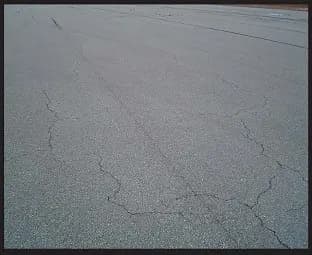 | Blocks are defined by cracks that are non-spalled (sides of the crack are vertical) or only lightly spalled, causing no FOD potential. Non-filled cracks have 1/4 inch (6 millimeters) or less mean width, and filled cracks have filler in satisfactory condition. |
| Medium | 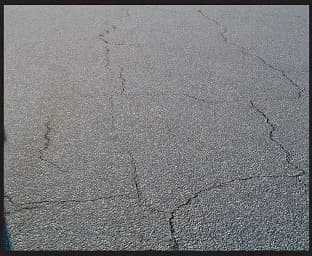 | Blocks are defined by either: (1) filled or non-filled cracks that are moderately spalled (some FOD potential); (2) non-filled cracks that are not spalled or have only minor spalling (some FOD potential), but have a mean width greater than approximately 1/4 inch (6 millimeters); or (3) filled cracks that are not spalled or have only minor spalling (some FOD potential), but have filler in unsatisfactory condition. |
| High | 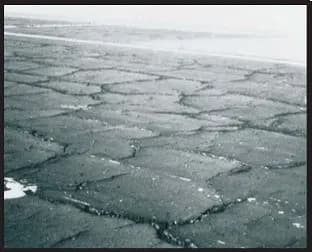 | Blocks are well-defined by cracks that are severely spalled, causing a definite FOD potential. |