Inspection Guidelines
Joint Reflection Cracking From PCC
This distress occurs only on pavements having an asphalt or tar surface over a PCC slab. This category does not include reflection cracking from any other type of base (i. e., cement stabilized, lime stabilized); such cracks are listed as longitudinal and transverse cracks. Joint-reflection cracking is caused mainly by movement of the PCC slab beneath the AC surface because of thermal and moisture changes; it is not load related. However, traffic loading may cause a breakdown of the AC near the crack, resulting in spalling and FOD potential. If the pavement is fragmented along a crack, the crack is said to be spalled. A knowledge of slab dimensions beneath the AC surface will help to identify these cracks.
How to Measure
Joint-reflection cracking is measured in linear feet (linear meters). The length and severity level of each crack should be identified and recorded. If the crack does not have the same severity level along its entire length, each portion should be recorded separately. For example, a crack that is 50 feet (5 meters) long may have 10 feet (3 meters) of high severity, 20 feet (6 meters) of medium severity, and 20 feet (6 meters) of light severity; these would all be recorded separately.
| Severity | Distress Example | Description |
|---|---|---|
| Low | 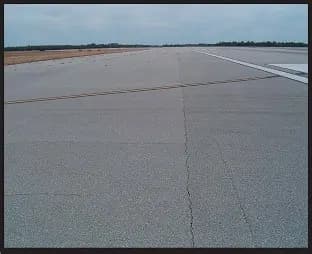 | Cracks have only light spalling (little or no FOD potential) or no spalling and can be filled or non-filled. If non-filled, the cracks have a mean width of 1/4 inch (6 millimeters) or less. Filled cracks are of any width, but their filler material is in satisfactory condition. |
| Medium | 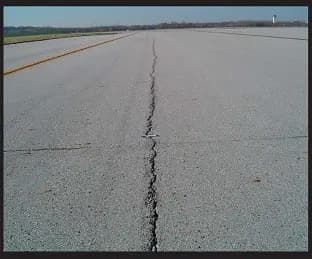 | One of the following conditions exists: (1) cracks are moderately spalled (some FOD potential) and can be either filled or non-filled of any width; (2) filled cracks are not spalled or are only lightly spalled, but the filler is in unsatisfactory condition; (3) non-filled cracks are not spalled or are only lightly spalled, but the mean crack width is greater than 1/4 inch (6 millimeters); or (4) light random cracking exists near the crack or at the corner of intersecting cracks. |
| High | 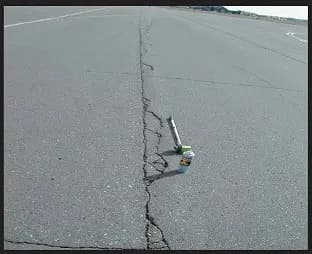 | Cracks are severely spalled (definite FOD potential) and can be either filled or non-filled of any width. |