Inspection Guidelines
Longitudinal and Transverse Cracking
Longitudinal cracks are parallel to the pavement's centerline or laydown direction. They may be caused by (1) a poorly constructed paving lane joint, (2) shrinkage of the AC surface due to low temperatures or hardening of the asphalt, or (3) a reflective crack caused by cracks beneath the surface course, including cracks in PCC slabs (but not at PCC joints). Transverse cracks extend across the pavement at approximately right angles to the pavement centerline or direction of laydown. They may be caused by items 2 or 3 above. These types of cracks are not usually load-associated. If the pavement is fragmented along a crack, the crack is said to be spalled.
How to Measure
Longitudinal and transverse cracks are measured in linear feet (linear meters). The length and severity of each crack should be identified and recorded. If the crack does not have the same severity level along its entire length, each portion of the crack having a different severity level should be recorded separately. For an example, see Joint-Reflection Cracking.
| Severity | Distress Example | Description |
|---|---|---|
| Low | 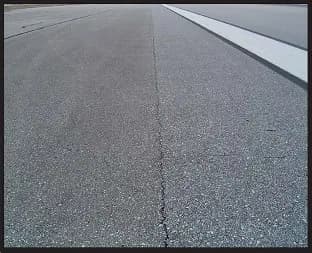 | Cracks have either minor spalling (little or no FOD potential) or no spalling. The cracks can be filled or non-filled. Non-filled cracks have a mean width of 1/4 inch (6 millimeters) or less; filled cracks are of any width, but their filler material is in satisfactory condition. |
| Medium | 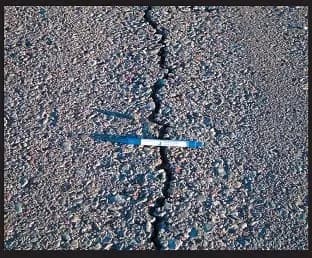 | One of the following conditions exists: (1) cracks are moderately spalled (some FOD potential) and can be either filled or non-filled of any width; (2) filled cracks are not spalled or are only lightly spalled, but the filler is in unsatisfactory condition; (3) non-filled cracks are not spalled or are only lightly spalled, but mean crack width is greater than 1/4 inch (6 millimeters); or (4) lightly random cracking exists near the crack or at the corners of intersecting cracks. |
| High | 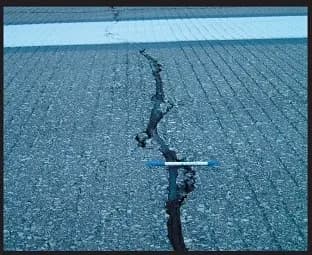 | Cracks are severely spalled, causing definite FOD potential. They can be either filled or non-filled of any width. |