Inspection Guidelines
Alligator or Fatigue Cracking
Alligator or fatigue cracking is a series of interconnecting cracks caused by fatigue failure of the asphalt surface under repeated traffic loading. The cracking initiates at the bottom of the asphalt surface (or stabilized base) where tensile stress and strain is highest under a wheel load. The cracks propagate to the surface initially as a series of parallel cracks. After repeated traffic loading, the cracks connect and form many- sided, sharp- angled pieces that develop a pattern resembling chicken wire or the skin of an alligator. The pieces are less than 2 feet (0.6 meters) on the longest side. Alligator cracking occurs only in areas that are subjected to repeated traffic loadings, such as wheel paths. Therefore, it would not occur over an entire area unless the entire area was subjected to traffic loading. (Pattern-type cracking, which occurs over an entire area that is not subject to loading, is rated as block cracking, which is not a load- associated distress.) Alligator cracking is considered a major structural distress.
How to Measure
Alligator cracking is measured in square feet (square meters) of surface area. The major difficulty in measuring this type of distress is that many times two or three levels of severity exist within one distressed area. If these portions can be easily distinguished from each other, they should be measured and recorded separately. However, if the different levels of severity cannot be easily divided, the entire area should be rated at the highest severity level present. If alligator cracking and rutting occur in the same area, each is recorded separately at its respective severity level.
| Severity | Distress Example | Description |
|---|---|---|
| Low | 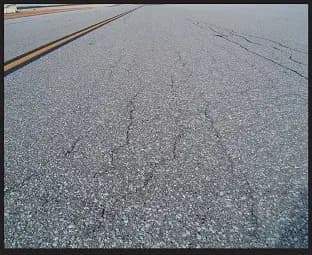 | Fine, longitudinal hairline cracks running parallel to each other with no or only a few interconnecting cracks. The cracks are not spalled. |
| Medium | 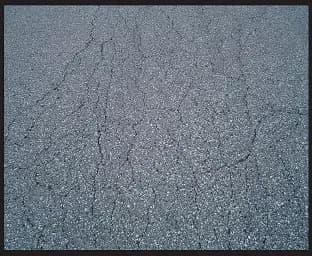 | Further development of light alligator cracking into a pattern or network of cracks that may be lightly spalled. |
| High | 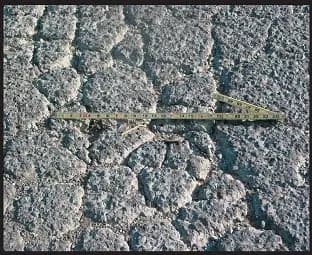 | Network or pattern cracking progressed so that pieces are well-defined and spalled at the edges; some of the pieces rock under traffic. |