Inspection Guidelines
Depression
Depressions are localized pavement surface areas having elevations slightly lower than those of the surrounding pavement. In many instances, light depressions are not noticeable until after a rain, when ponding water creates "birdbath" areas; but the depressions can also be located without rain because of stains created by ponding water. Depressions can be caused by settlement of the foundation soil or can be "built up" during construction. Depressions cause roughness and, when filled with water of sufficient depth, can cause hydroplaning of aircraft.
How to Measure
Depressions are measured in square feet (square meters) of surface area. The maximum depth of the depression determines the level of severity. This depth can be measured by placing a 10-foot 3-meter straightedge across the depressed area and measuring the maximum depth in millimeters (inches). Depressions larger than 10 feet (3 meters) across must be measured by either visual estimation or direct measurement when filled with water.
| Severity | Distress Example | Description |
|---|---|---|
| Low | 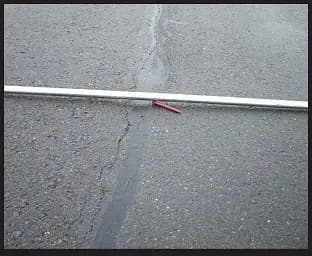 | Depression can be observed or located by stained areas, only slightly affects pavement riding quality, and may cause hydroplaning potential on runways (see measurement criteria below). Runways and High-Speed Taxiways: < 1/8 to 1/2 inch (< 3.2 to 12.7 mm) Taxiways and Aprons: 1/2 to 1 inch (< 12.7 to 25.4 mm) |
| Medium |  | The depression can be observed, moderately affects pavement riding quality, and causes hydroplaning potential on runways (see measurement criteria below). Runways and High-Speed Taxiways: 1/2 to 1 inch (12.7 to 25.4 mm) Taxiways and Aprons: 1 to 2 inches (25.4 to 50.8 mm) |
| High | 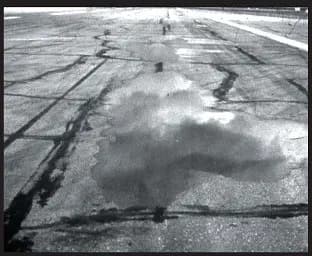 | The depression can be readily observed, severely affects pavement riding quality, and causes definite hydroplaning potential (see measurement criteria below). Runways and High-Speed Taxiways: > 1 inch (> 25.4 mm) Taxiways and Aprons: > 2 inches (> 50.8 mm) |