Inspection Guidelines
Alkali Silica Reaction (ASR)
ASR is caused by chemical reaction between alkalis and certain reactive silica minerals which form a gel. The gel absorbs water, causing expansion which may damage the concrete and adjacent structures. Alkalis are most often introduced by the portland cement within the pavement. ASR cracking may be accelerated by chemical pavement deicers. Visual indicators that ASR may be present include: 1 Cracking of the concrete pavement (often in a map pattern). 2 White, brown, gray or other colored gel or staining may be present at the crack surface. 3 Aggregate popouts. 4 Increase in concrete volume (expansion) that may result in distortion of adjacent or integral structures or physical elements. Examples of expansion include shoving of asphalt pavements, light can tilting, slab faulting, joint misalignment, and extrusion of joint seals or expansion joint fillers. Because ASR is material-dependent, ASR is generally present throughout the pavement section. Coring and concrete petrographic analysis is the only definitive method to confirm the presence of ASR. The following should be kept in mind when identifying the presence of ASR through visual inspection: 1 Generally ASR distresses are not observed in the first few years after construction. In contrast, plastic shrinkage cracking can occur the day of construction and is apparent within the first year. 2 ASR is differentiated from D-Cracking by the presence of cracking perpendicular to the joint face. D-Cracking predominantly develops as a series of parallel cracks to joint faces and linear cracking within the slab. 3 ASR is differentiated from Map Cracking/ Scaling by the presence of visual signs of expansion.
How to Count
No other distresses should be recorded if high severity ASR is recorded.
| Severity | Distress Example | Description |
|---|---|---|
| Low | 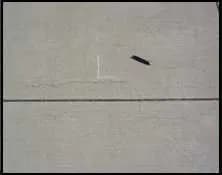 | Minimal to no Foreign Object Damage (FOD) potential from cracks, joints or ASR related popouts; cracks at the surface are tight (predominantly 1 mm or less). Little to no evidence of movement in pavement or surrounding structures or elements. |
| Medium | 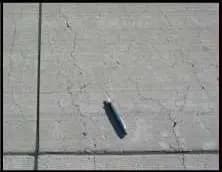 | Some FOD potential; increased sweeping or other FOD removal methods may be required. May be evidence of slab movement and/ or some damage to adjacent structures or elements. Medium ASR distress is differentiated from low by having one or more of the following: increased FOD potential, increased cracking of the slab, some fragments along cracks or at crack intersections present, surface popouts of concrete may occur, pattern of wider cracks (predominantly 1 mm or wider) that may be subdivided by tighter cracks. |
| High | 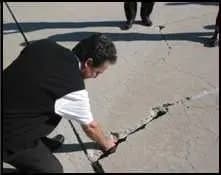 | One or both of the following exist: 1) Loose or missing concrete fragments which pose high FOD potential, 2) Slab surface integrity and function significantly degraded and pavement requires immediate repair; may also require repairs to adjacent structures or elements. |