Inspection Guidelines
Corner Break
A corner break is a crack that intersects the joints at a distance less than or equal to one-half the slab length on both sides, measured from the corner of the slab. For example, a slab with dimensions of 25 by 25 feet (7.5 by 7.5 meters) that has a crack intersecting the joint 5 feet (1.5 meters) from the corner on one side and 17 feet (5 meters) on the other side is not considered a corner break; it is a diagonal crack. However, a crack that intersects 7 feet (2.1 meters) on one side and 10 feet (3 meters) on the other is considered a corner break. A corner break differs from a corner spall in that the crack extends vertically through the entire slab thickness, while a corner spall intersects the joint at an angle. Load repetition combined with loss of support and curling stresses usually causes corner breaks.
How to Count
A distressed slab is recorded as one slab if it (1) contains a single corner break, (2) contains more than one break of a particular severity, or (3) contains two or more breaks of different severities. For two or more breaks, the highest level of severity should be recorded. For example, a slab containing both light and medium-severity corner breaks should be counted as one slab with a medium-severity corner break.
| Severity | Distress Example | Description |
|---|---|---|
| Low |  | Crack has either no spalling or minor spalling (no foreign object damage (FOD) potential). If non-filled, it has a mean width less than approximately 1/8 inch (3 millimeters); a filled crack can be of any width, but the filler material must be in satisfactory condition. The area between the corner break and the joints is not cracked. |
| Medium | 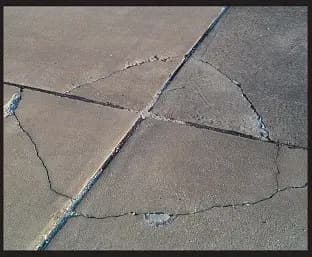 | One of the following conditions exists: (1) filled or non-filled crack is moderately spalled (some FOD potential); (2) a non-filled crack has a mean width between 1/8 inch (3 millimeters) and 1 inch (25 millimeters); (3) a filled crack is not spalled or only lightly spalled, but the filled is in unsatisfactory condition; (4) the area between the corner break and the joints is lightly cracked with loose or missing particles. |
| High | 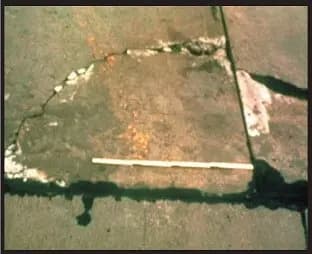 | One of the following conditions exists: (1) filled or non-filled crack is severely spalled, causing definite FOD potential; (2) a non-filled crack has a mean width greater than approximately 1 inch (35 millimeters), creating a tire damage potential; or (3) the area between the corner break and the joints is severely cracked. |