Inspection Guidelines
Scaling
Surface deterioration caused by construction defects, material defects and environmental factors. Generally scaling is exhibited by delamination or disintegration of the slab surface to the depth of the defect. Construction defects include: over-finishing, addition of water to the pavement surface during finishing, lack of curing, attempted surface repairs of fresh concrete with mortar. Generally this occurs over a portion of a slab. Material defects include: inadequate air entrainment for the climate. Generally this occurs over several slabs that were affected by the concrete batches. Environmental factors: freezing of concrete before adequate strength gained or thermal cycles from certain aircraft. Generally over a large area for freezing, and isolated areas for thermal effects. Typically, the FOD from scaling is removed by sweeping, but the concrete will continue to scale until the affected depth is removed or expended.
How to Count
If two or more levels of severity exist on a slab, the slab is counted as one slab having the maximum level of severity. If "D" cracking or ASR is counted, scaling is not counted.
| Severity | Distress Example | Description |
|---|---|---|
| Low | 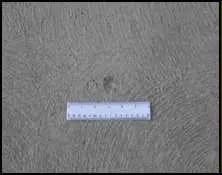 | Minimal loss of surface paste that poses no FOD hazard. No FOD potential. |
| Medium | 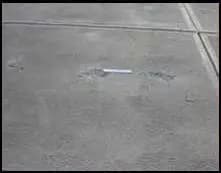 | The loss of surface paste that poses some FOD potential including isolated fragments of loose mortar, exposure of the sides of coarse aggregate (less than 1/4 of the width of coarse aggregate), or evidence of coarse aggregate coming loose from the surface. |
| High | 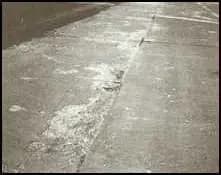 | The high severity is associated with low durability concrete that will continue to pose a high FOD hazard; normally the layer of surface mortar is observable at the perimeter of the scaled area, and is likely to continue to scale due to environmental or other factors. Indication of high severity FOD is that routine sweeping is not sufficient to avoid FOD issues. |