Inspection Guidelines
Spalling - Corner
Corner spalling is the raveling or breakdown of the slab within approximately 2 feet (600 millimeters) of the corner. A corner spall differs from the corner break in that the spall angles downward to intersect the joint, while a break extends vertically through the slab.
How to Count
If one or more corner spalls having the same severity level are located in a slab, the slab is counted as one slab with corner spalling. If more than one severity level occurs, it is counted as one slab having the higher severity level.
| Severity | Distress Example | Description |
|---|---|---|
| Low | 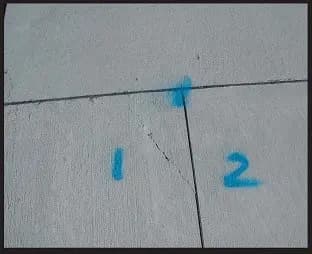 | One of the following conditions exists: (1) spall is broken into one or two pieces defined by low-severity cracks (little or no FOD potential), (2) spall is defined by one medium-severity crack (little or no FOD potential). |
| Medium | 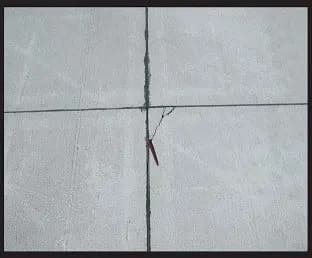 | One of the following conditions exists: (1) spall is broken into two or more pieces defined by medium- severity crack(s), and a few small fragments may be absent or loose; (2) spall is defined by one severe, fragmented crack that may be accompanied by a few hairline cracks; or (3) spall has deteriorated to the point where loose material is causing some FOD potential. |
| High | 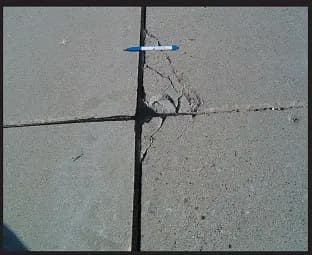 | One of the following conditions exists: (1) spall is broken into two or more pieces defined by high- severity fragmented crack(s), with loose or absent fragments; (2) pieces of the spall have been displaced to the extent that a tire damage hazard exists; or (3) spall has deteriorated to the point where loose material is causing high FOD potential. |