Inspection Guidelines
Durability - D Cracking
Durability cracking is caused by the inability of the concrete to withstand environmental factors such as freeze-thaw cycles. It usually appears as a pattern of cracks running parallel to a joint or linear crack. A dark coloring can usually be seen around the ?ne durability cracks. This type of cracking may eventually lead to disintegration of the concrete within 1 to 2 feet (300 to 600 millimeters) of the joint or crack.
How to Count
When the distress is located and rated at one severity, it is counted as one slab. If more than one severity level is found, the slab is counted as having the higher severity distress. If "D" cracking is counted, scaling on the same slab should not be recorded.
| Severity | Distress Example | Description |
|---|---|---|
| Low | 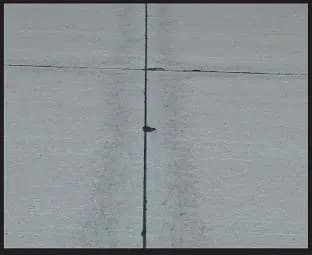 | "D" cracking is defined by hairline cracks occurring in a limited area of the slab, such as one or two corners or along one joint. Little or no disintegration has occurred. No FOD potential. |
| Medium | 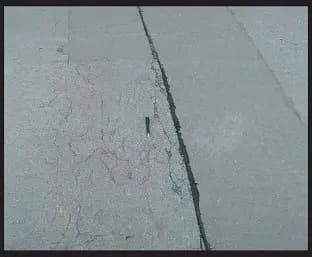 | (1) "D" cracking has developed over a considerable amount of slab area with little or no disintegration or FOD potential; or (2) "D" cracking has occurred in a limited area of the slab, such as in one or two corners or along one joint, but pieces are missing and disintegration has occurred. Some FOD potential. |
| High | 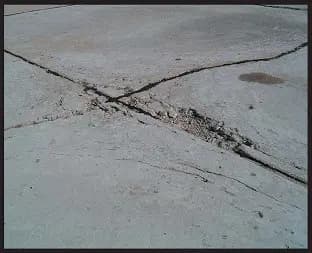 | "D" cracking has developed over a considerable amount of slab area with disintegration of FOD potential. |