Inspection Guidelines
Spalling - Trans. And Long. Joints
Joint spalling is the breakdown of the slab edges within 60 millimeters (2 feet) of the side of the joint. A joint spall usually does not extend vertically through the slab but intersects the joint at an angle. Spalling results from excessive stresses at the joint or crack caused by infiltration of incompressible materials or traffic loads. Weak concrete at the joint (caused by overworking) combined with traffic loads also causes spalling.
How to Count
If the joint spall is located along the edge of one slab, it is counted as one slab with joint spalling. If spalling is located on more than one edge of the same slab, the edge having the highest severity is counted and recorded as one slab. Joint spalling can also occur along the edges of two adjacent slabs. If this is the case, each slab is counted as having joint spalling. If a joint spall is small enough to be filled during a joint seal repair, it should not be recorded.
| Severity | Distress Example | Description |
|---|---|---|
| Low | 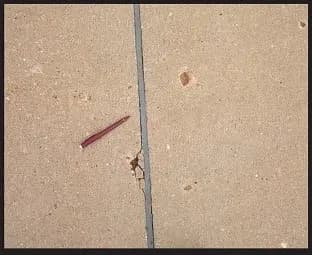 | Spall Length < 2 feet (600 mm): Spall is broken into pieces or fragmented; little FOD or tire damage potential exists. Spall Length > 2 feet (600 mm): (a) Spall is broken into no more than three pieces defined by low- or medium-severity cracks; little or no FOD potential exists; or (b) Joint is lightly frayed; little or no FOD potential exists. |
| Medium | 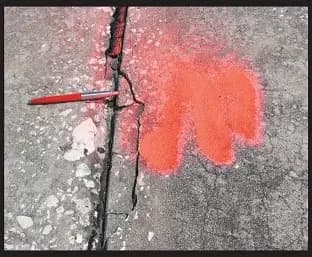 | Spall Length < 2 feet (600 mm): Spall is broken into pieces or fragmented, with some of the pieces loose or absent, causing considerable FOD or tire damage potential. Spall Length > 2 feet (600 mm): (a) Spall is broken into more than three pieces defined by light or medium cracks; or (b) Spall is broken into no more than three pieces with one or more of the cracks being severe with some FOD potential existing; or (c) Joint is moderately frayed, with some FOD potential. |
| High | 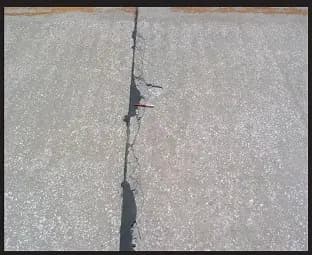 | Spall Length > 2 feet (600 mm): (1) Spall is broken into more than three pieces defined by one or more high-severity cracks with high FOD potential; or (2) Joint is severely frayed, with high FOD potential. (Note: If less than 2 feet (600 mm) of the joint is lightly frayed, the spall should not be counted.) |